Meeting Accountability Tracking: How to Make Sure Commitments Actually Get Done
Meeting accountability tracking turns spoken commitments into a system you can check on. Learn how to hold your team accountable without micromanaging.

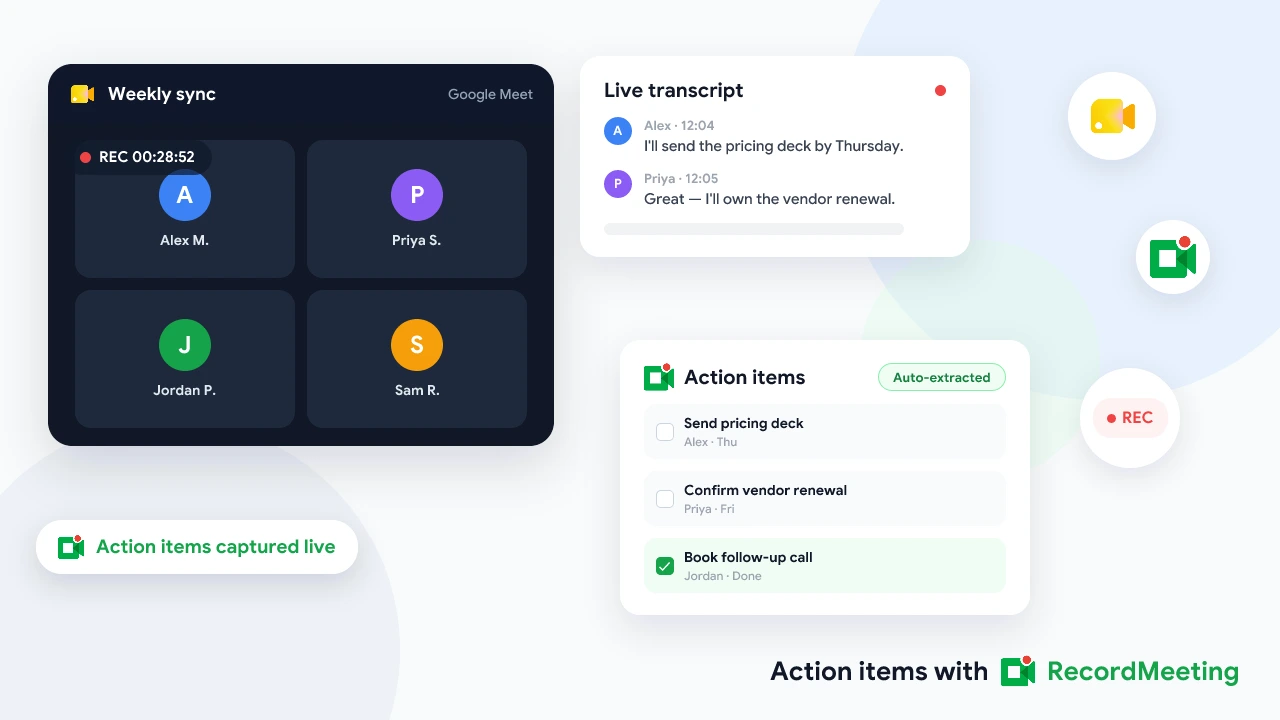
A meeting ends, five commitments were made out loud, and three weeks later two of them are still sitting untouched. Nobody lied. Nobody was careless. The commitment simply had nowhere to live once the call ended, so it quietly slipped, and nobody noticed until it mattered.
Meeting accountability tracking is the system that catches this before it becomes a pattern. It is different from writing down a task list for a single meeting. It is the ongoing practice of watching whether commitments made across a series of meetings actually get honored, and building a habit around checking rather than hoping. This guide covers how to build that system, run it without turning into a micromanager, and use what you already record to make the whole thing effortless.
What Meeting Accountability Tracking Actually Is
Meeting accountability tracking and action item tracking sound like the same thing, but they solve different problems. Action item tracking is about a single meeting: capturing the task, naming an owner, setting a date. We cover that mechanic in detail in our guide to never missing a meeting action item.
Accountability tracking is the layer above that. It asks a different question: across the last ten meetings, who follows through and who doesn’t, which types of commitments consistently stall, and is the team’s overall follow-through rate improving or getting worse. One meeting’s task list tells you what was promised. Accountability tracking tells you whether promises, as a pattern, are worth anything.
This matters because most teams are good at the first part and terrible at the second. They write action items every week and never once look back to see if last month’s commitments got done. Without that second layer, a task list is just a diary of good intentions.
How to Hold Your Team Accountable Without Micromanaging
The instinct when accountability slips is to check in more often, which usually backfires. Constant status pings read as distrust, and people start performing busyness instead of actually finishing work. A few approaches hold the line without crossing into micromanagement.
Make the commitment public, not private
A task assigned quietly in a one-on-one is easy to let slide because only two people know it exists. A task confirmed out loud in a team meeting, in front of the group, carries social weight that a private message never will. Public commitments get honored more often simply because more people would notice if they didn’t.
Ask about blockers, not progress
“How’s it going?” invites a vague, reassuring answer. “What’s blocking this?” invites an honest one. People are far more willing to admit they are stuck than to admit they are behind, so asking about obstacles surfaces the real status faster than asking for a progress update ever will.
Review the pattern, not the person
Bring data instead of suspicion. “Three of the last five design tasks slipped past their date” is a system observation. “You keep missing deadlines” is a personal attack. The first opens a conversation about process. The second makes people defensive and less likely to be honest next time.
Let the record speak for itself
If a commitment is in question, the fastest way to settle it without an argument is to check what was actually said. If you record your Google Meet calls, you have a transcript to search instead of relying on two people’s competing memories of who agreed to what.
Running a Weekly Accountability Meeting
A dedicated accountability check-in works best as a short, recurring ritual rather than a one-off review. Keep it separate from your regular status meeting so it does not get diluted by unrelated updates.
- Start with last week’s list. Pull up every commitment made in the last cycle before discussing anything new. This is the whole point of the meeting, so it goes first, not last.
- Mark each item done, in progress, or stuck. Three states are enough. More categories just give people places to hide.
- Ask “what changed?” on anything stuck. A task that stalls for the same reason two weeks running is not a scheduling problem, it is a resourcing or priority problem that needs a decision, not another reminder.
- Close the loop publicly. Announce what got done. This is the step teams skip most often, and it is the one that makes the whole system feel worth participating in.
- Only then move to new commitments. New tasks compound the same way old ones did. Adding them before reviewing the backlog just buries last week’s unfinished work under this week’s new promises.
Keep this meeting under fifteen minutes for a small team. The moment it starts running long, it has turned into a status meeting, and the accountability signal gets lost in the noise.
 Try Record Meeting
Record Google Meet from the browser and get an AI summary with action items pulled out automatically, so every commitment has a written record to check against later.
Get Started Free
Tracking Accountability Metrics Across Meetings
A single meeting’s task list cannot tell you whether accountability is improving. For that, you need a metric you check over time, not per meeting.
The simplest one is a follow-through rate: of everything committed to in a given period, what percentage actually got done by its due date. Calculate it monthly, not weekly. Weekly numbers bounce around too much on small sample sizes to mean anything, while a monthly view shows whether the trend is genuinely moving.
A few things worth watching alongside that single number:
- Which categories of task stall most. If cross-team commitments slip far more than within-team ones, the problem is probably a handoff issue, not an individual accountability issue.
- Whether the same person or team shows up in “stuck” repeatedly. One slip is normal. A pattern is a signal that priorities, capacity, or workload need an honest conversation, not another reminder.
- How long items sit in “stuck” before anyone escalates. A task that stays stuck for one meeting and gets resolved is healthy friction. A task that stays stuck for six meetings in a row means nobody is actually watching the tracker.
Having an accurate transcript of each meeting makes this far easier to audit, since you can go back and confirm what was actually promised instead of relying on whoever wrote the recap that week. Our guide on auto-generating a Google Meet summary covers how to pull a clean, structured record out of every call without manual note-taking.
A Simple Accountability Tracker Template
Unlike a per-meeting action item list, this tracker looks across a whole cycle and tracks people and patterns, not just individual tasks. Keep it in whatever tool your team already checks daily, whether that is a shared doc, a spreadsheet, or a project board.
| Person / Team | Commitments this cycle | Completed on time | Stuck (2+ cycles) | Follow-through rate |
|---|---|---|---|---|
| Alex | 4 | 3 | 0 | 75% |
| Product team | 6 | 4 | 1 | 67% |
| Kim | 3 | 3 | 0 | 100% |
A few rules that keep this useful instead of another spreadsheet nobody opens:
- Update it at the accountability meeting, not between meetings. A tracker that only gets touched once a week during the actual review stays accurate. One that people are supposed to update ad hoc drifts out of date within a month.
- Review the rate trend, not a single week’s number. One bad week is noise. Three declining months in a row is a real signal worth a conversation.
- Keep it visible to the whole team, not just the manager. A private tracker only the manager sees turns into a surveillance tool. A shared one turns into a team habit.
If your team already sends a written recap after every call, our meeting recap email template pairs well with this tracker, since the recap captures the commitment and the tracker captures whether it landed.
Frequently Asked Questions
Bottom Line
A task list only proves something was written down. Meeting accountability tracking proves something actually happened. Build the habit of reviewing last cycle’s commitments before adding new ones, keep the review focused on patterns instead of blame, and measure a follow-through rate over months rather than judging any single week.
If you are already recording your Google Meet calls, you have an exact record of what was promised whenever a commitment is in question. Try Record Meeting to capture the transcript and summary automatically, then build the accountability tracker above around whatever commitments come out of your next meeting.