Is It Legal to Record a Meeting Without Telling Participants? (2026 Guide)
Can you record a meeting without telling participants? A state-by-state and country-by-country look at consent laws, workplace rules, and what happens if you get it wrong.

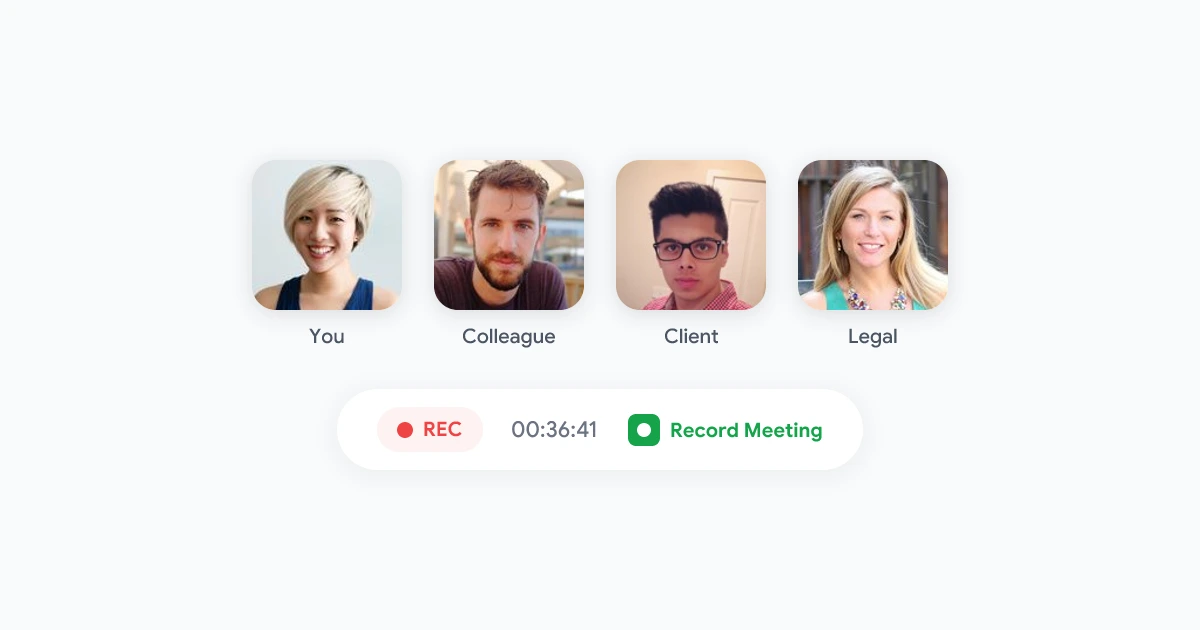
Someone on your team asks: “Can I just record this meeting without telling everyone on the call?” It sounds like a small question. It isn’t. The answer depends on which state or country each participant is sitting in, what kind of meeting it is, and whether you are recording a colleague, a client, or an employee.
This guide walks through the actual consent rules that apply in 2026, what counts as “telling” someone under the law, and where the line sits between what is legal and what is simply a bad idea. If you are trying to work out whether the browser extension you use flags participants automatically, or whether that even matters legally, this is the article for that question.
What “Without Telling Participants” Actually Means Legally
There is a difference between three things people often lump together:
- No verbal announcement, but the platform shows a recording indicator to everyone on the call.
- No platform indicator, but you mentioned at the start that you would be recording.
- No announcement and no indicator at all. Nobody on the call has any way to know a recording exists.
Only the third scenario is what consent law actually cares about. If Zoom, Teams, or Google Meet displays its native “Recording in progress” banner, courts generally treat that as adequate notice even if you never say a word out loud. The legal risk shows up specifically when there is no notice of any kind, verbal or visual, and someone finds out later that a recording exists.
That distinction matters because most people asking this question are not trying to spy on anyone. They just want their own transcript without disrupting the flow of the call by announcing it. Whether that is fine depends entirely on jurisdiction.
One-Party Consent vs. All-Party Consent
US recording law splits into two categories, and this single distinction decides most cases.
One-party consent means that as long as one person on the call (you) knows the recording is happening, that is legally sufficient. You do not need to tell anyone else. This is federal law under the Wiretap Act, and it is the rule in the majority of US states, including New York, Texas, Ohio, and Georgia.
All-party consent (sometimes called two-party consent) means every single participant must know before you record. As of 2026, the states that require this are:
- California
- Florida
- Illinois
- Pennsylvania
- Washington
- Connecticut
- Delaware
- Maryland
- Massachusetts
- Michigan
- Montana
- Nevada
- New Hampshire
- Vermont
If even one participant is physically located in one of these states, that state’s stricter rule typically governs the call, regardless of where you are. A call between someone in Texas and someone in California should follow California’s all-party rule to stay safe.
For a full breakdown of how this interacts with company policy and documentation, see our meeting recording policy template for HR and legal teams.
Recording Employees or Colleagues Without Telling Them
Workplace recording adds a layer beyond basic consent law: employment and labor rules.
Employers recording employee meetings. Even in one-party consent states, secretly recording an employee during a performance review, disciplinary meeting, or termination conversation can create separate legal exposure under labor law, especially if the recording is later used as evidence without the employee’s knowledge that it exists. Many companies require documented, upfront disclosure in employment agreements or meeting invites specifically to avoid this ambiguity.
Employees recording their manager or coworkers. This works the other way too. An employee recording a 1:1 with their manager, without saying so, is legal in one-party consent states as long as the employee is a genuine participant in the conversation. It becomes a problem the moment the employee is not actually part of the call (leaving a recorder running in an empty room, for example) or is in an all-party consent state.
The safest workplace default: put recording expectations directly into your internal meeting policy so nobody has to guess on a call-by-call basis. Our meeting recording etiquette guide for remote teams covers how teams typically write this into onboarding and team norms.
International Rules: UK, Canada, and the EU
Outside the US, the picture is different again.
United Kingdom: one-party consent, similar to most of the US. You can record a conversation you are part of without telling the other participants, though workplace and data protection rules (UK GDPR) still apply to how you store and share that recording afterward.
Canada: one-party consent federally, but recording is still subject to Canadian privacy law (PIPEDA) once the recording is stored or shared, particularly for business purposes.
European Union: this is where it gets stricter. GDPR treats a voice or video recording as personal data the moment it captures an identifiable person. Even in a one-party consent sense, recording an EU-based participant without informing them can violate GDPR’s transparency and lawful-basis requirements, separate from wiretapping law entirely. Business meetings with EU participants should include disclosure regardless of where the recorder is physically located.
For the full EU-specific requirements, including lawful basis, retention limits, and cross-border data transfer rules, see our GDPR meeting recording guide.
 Try Record Meeting
Record Meeting captures Google Meet calls straight from your browser, no bot joining the call, and gives you a transcript and AI summary the moment the meeting ends.
Get Started Free
Does Your Video Platform Notify Participants When You Record?
The law cares about notice, and different tools handle notice differently.
- Zoom shows a visible “Recording…” indicator to every participant and can play an audio announcement when a local or cloud recording starts.
- Microsoft Teams displays a banner and a chat message announcing that recording has begun, visible to the whole call.
- Google Meet’s native recording shows a red recording icon and a notification banner the moment a host or co-host starts it. This is the platform’s own consent mechanism, and it applies only to the native record button, not to third-party tools.
- Browser-based recording tools like Record Meeting capture the call from your own browser session and do not trigger a Google Meet, Zoom, or Teams in-call banner, because the capture happens outside the platform’s own recording feature.
That last point is exactly why disclosure matters more, not less, when you use a browser extension. The platform is not doing the notice job for you. If you are in an all-party consent jurisdiction or dealing with EU participants, you need to say something yourself, even if the tool itself stays invisible in the meeting UI.
When Silent Recording Is Legal but Still a Bad Idea
Being legally allowed to record without telling anyone and having good reason to do it are two different things.
Cases where silent recording, while legal in one-party states, still damages trust if discovered:
- Recording a colleague’s casual conversation “just in case,” with no clear purpose
- Keeping a running recording of every 1:1 without ever mentioning it exists
- Recording a negotiation and using it later as leverage the other party didn’t expect
Cases where quick disclosure costs nothing and removes all risk:
- A simple “I’m going to record this so I don’t miss anything, that OK?” at the start of the call
- A calendar invite line noting that meetings on this recurring series are recorded for internal notes
- A team-wide policy stated once, rather than repeated every call
The practical rule most legal teams land on: disclosure is nearly free, and the downside of skipping it (a resentful colleague, a legal complaint, an all-party consent violation you didn’t realize applied) is not. When you are unsure which jurisdiction’s rule applies because participants are spread across states or countries, default to announcing it.
For the security side of what happens to a recording after it is captured, our guide on Google Meet recording privacy and security covers storage, access, and sharing controls.
Try Record Meeting
Get a full transcript, speaker labels, and an AI summary for every Google Meet call, without asking the host to start anything.
Get Started Free
How to Record Meetings the Right Way
A simple checklist covers almost every situation:
- Identify where participants are located. If anyone is in an all-party consent state, the EU, or another jurisdiction with strict rules, plan to disclose.
- Say it once, plainly. “I’m recording this for my own notes” at the start of the call satisfies every jurisdiction’s requirement, one-party or all-party.
- Put recurring meeting recording in the invite. For standing meetings, a one-line note in the calendar description covers every future instance.
- Write it into your team policy. New hires and external guests should not have to guess your team’s default. See our meeting recording policy template for language you can adapt.
- Keep recordings only as long as you need them. Retention limits reduce your exposure even in jurisdictions where the recording itself was legal to make.
If you record calls with Google Meet participants who are not the host, and you want your own transcript without asking anyone to change how the meeting is run, our guide on recording Google Meet without host permission covers the mechanics and the etiquette side of that specific case.
FAQ
Conclusion
Whether you can record a meeting without telling participants comes down to one question: where is everyone sitting? One-party consent jurisdictions give you legal room to skip the announcement. All-party consent states, most EU countries, and most workplace disciplinary contexts do not.
The practical answer for most teams is simple: say it once, keep it short, and put your default policy somewhere everyone can see it. That small habit removes the guesswork on every future call.
If you want a browser-based way to capture Google Meet calls with a full transcript and AI summary, without a bot joining and without disrupting how the meeting runs, Record Meeting is built for exactly that.