Meeting Recording GDPR Compliance: The IT and Compliance Team Checklist
Meeting recording GDPR compliance goes beyond consent. Here is the DPIA, vendor, works council, and security checklist IT and compliance teams actually need.

Most teams solve the easy part of meeting recording GDPR compliance on day one: they pick a lawful basis and they tell people the call is being recorded. Then a customer’s security questionnaire asks for a Data Processing Agreement with your recording vendor, or an employee in Germany asks whether the works council signed off, and nobody has an answer. That is where compliance programs actually stall, not on consent.
This guide is the second half of the story. If you need the fundamentals first, our GDPR meeting recording guide covers lawful basis, consent, retention, and data subject rights in depth. Here we walk through the artifacts an IT or compliance team needs to produce: a DPIA decision, a Records of Processing Activities entry, a vendor due diligence file, an employee consultation record, and a security checklist you can hand to an auditor.
Why “We Ask for Consent” Is Not the Same as Compliant
A recording program can announce every call, keep a tidy retention schedule, and still fail a compliance review because nobody documented the decisions behind it. GDPR’s accountability principle means you have to show your work, not just do the right thing quietly. For meeting recording specifically, that paperwork usually falls into five buckets:
- A documented decision on whether the processing needs a formal risk assessment
- An entry in your organization’s record of what personal data you process and why
- A due diligence file on every recording or transcription vendor you use
- Proof that employee representatives were consulted, where required
- A written set of technical and organizational security measures
Miss one of these and the recording itself can be perfectly lawful while your compliance file is empty. Here is how to fill each bucket.
Do You Need a DPIA for Meeting Recording?
A Data Protection Impact Assessment (DPIA) is a formal risk assessment GDPR requires before you start processing that is “likely to result in a high risk” to people’s rights. Most routine internal meeting recording does not clear that bar. Recording sales calls, standups, or training sessions with a clear notice and a short retention window is normal, low-risk business activity.
You should run a DPIA, or at least document why you decided not to, when meeting recording overlaps with any of these:
- Systematic monitoring of employees, such as recording every customer support call for performance scoring rather than occasional spot checks
- Special category data on a large scale, for example health details discussed in HR or medical intake calls
- New technology at scale, such as rolling out AI transcription or emotion analysis across the whole organization for the first time
- Automated decisions based on the recording, like an algorithm that scores sales reps or flags “risky” calls without human review
If none of those apply, a short internal note explaining why a full DPIA was not necessary is enough to satisfy an auditor. If one does apply, the DPIA itself should describe the processing, assess necessity and proportionality, identify risks to the people recorded, and list the measures you will take to reduce them, things like access restrictions, shorter retention, or redaction of sensitive segments.
Add Meeting Recording to Your Records of Processing Activities
Article 30 of GDPR requires most organizations to keep a Records of Processing Activities (ROPA) log, essentially an inventory of what personal data you process, why, and how. Meeting recording is easy to forget here because it feels like infrastructure rather than a distinct “processing activity.”
A ROPA entry for meeting recording should capture:
| Field | Example |
|---|---|
| Purpose | Internal note-taking, sales call review, training |
| Categories of data | Voice, video, name, screen-shared content, AI transcript |
| Categories of people | Employees, customers, candidates |
| Lawful basis | Legitimate interests (internal) or consent (customer calls) |
| Retention period | 90 days internal, contract length for customer calls |
| Recipients | Internal team only, or named third parties |
| International transfers | Where the recording tool stores and processes data |
| Security measures | Encryption at rest, access controls, audit logging |
If you already keep a ROPA for other systems, add recording as its own line item rather than folding it into a generic “communications” entry. Regulators and auditors specifically look for it by name.
 Try Record Meeting
Record Google Meet from the browser with no bot joining the call. Recordings, transcripts, and summaries stay inside your own Google Workspace, which keeps your ROPA entry and access controls simple.
Get Started Free
Vetting Your Recording Vendor: DPAs, Sub-Processors, and Transfers
Any recording or transcription tool that is not built entirely in-house is a data processor acting on your instructions. GDPR requires a written contract, a Data Processing Agreement (DPA), between you and that vendor before you send them any personal data. This is the piece most teams skip, because signing up for a recording tool feels like installing software, not appointing a processor.
Before you rely on a vendor for meeting recording, confirm the following.
What the DPA must cover
- The categories of data processed (audio, video, transcripts) and the purpose
- Confirmation the vendor only processes data on your documented instructions
- Confidentiality obligations for anyone with access on the vendor’s side
- Security measures, ideally referencing a specific standard or certification
- Breach notification timelines from the vendor back to you
- Deletion or return of data when you stop using the tool
- A list of the vendor’s own sub-processors, so you know who else touches the recording
Most reputable vendors publish a DPA you can accept online or request from sales. If a tool cannot produce one, that is a disqualifying red flag for any business use, not a minor gap.
International data transfers
If your recording vendor processes or stores data outside the EU or UK, you need a valid transfer mechanism, typically the European Commission’s Standard Contractual Clauses (SCCs), layered on top of the DPA. Ask directly where the recordings and transcripts are processed and stored, not just where the company is headquartered. Keeping recordings inside infrastructure you already control, rather than a separate vendor’s cloud in an unclear jurisdiction, removes this question almost entirely.
Works Councils and Employee Consultation
This is the step most guides skip, and the one that trips up multinational teams the hardest. In several EU countries, recording employees during meetings counts as a form of workplace monitoring, which triggers employee representation rights that sit alongside GDPR rather than inside it.
- Germany. A Betriebsrat (works council) generally has co-determination rights over technical systems capable of monitoring employee conduct or performance. Rolling out meeting recording or call-scoring tools without works council agreement is a common and costly compliance gap.
- France and the Netherlands. Similar consultation obligations apply through the comité social et économique and the ondernemingsraad, particularly for tools that log or analyze employee behavior.
- Works council scope. The trigger is usually the capability to monitor, not whether you actually review every recording. A tool that could be used to evaluate performance often needs sign-off even if you only use it for note-taking today.
If your organization operates in a country with statutory employee representation, loop in HR and local counsel before a recording rollout, not after. A signed works council agreement, or a documented finding that one is not required, belongs in the same compliance file as your DPIA and ROPA entry.
Technical and Organizational Security Measures Checklist
GDPR requires security measures “appropriate to the risk,” which is intentionally vague. For meeting recordings specifically, auditors and customer security questionnaires tend to look for the same concrete list:
- Encryption in transit and at rest for recordings, transcripts, and summaries
- Role-based access, so recordings are visible only to people with a business reason to see them, not the whole organization by default
- No public link sharing as a default setting, with “anyone with the link” disabled unless explicitly chosen
- Audit logging of who viewed, downloaded, or shared a recording
- Automated retention and deletion, tied to the schedule in your ROPA entry rather than manual cleanup
- Multi-factor authentication on any account that can access the recording archive
- Documented incident response steps specifically for a recording or transcript being exposed or mis-shared
Write this list down once as a short internal standard, then point every new recording tool evaluation at it. It turns “is this compliant” from a debate into a checklist.
What Counts as a Breach Involving a Meeting Recording
A personal data breach is any incident that leads to accidental or unlawful destruction, loss, alteration, or unauthorized disclosure of personal data. For meeting recordings, the realistic scenarios are:
- A recording shared with “anyone with the link” and forwarded outside the organization
- A recording accidentally sent to the wrong distribution list
- A vendor account compromise exposing stored recordings or transcripts
- A departing employee retaining access to a shared drive of recordings after offboarding
If any of these happen and the recording contains personal data, you generally have 72 hours to notify your supervisory authority, and in higher-risk cases the affected individuals as well. Having recordings centralized in one access-controlled location, rather than scattered across personal drives and chat downloads, is what makes it possible to even scope a breach quickly enough to hit that window. For the broader picture of where recordings end up and who can reach them, see our Google Meet recordings privacy guide.
The Full Compliance Checklist
Use this as the punch list for a recording program review:
- Lawful basis chosen and documented for each recording use case
- Recording notice given every time, verbally and in the invite
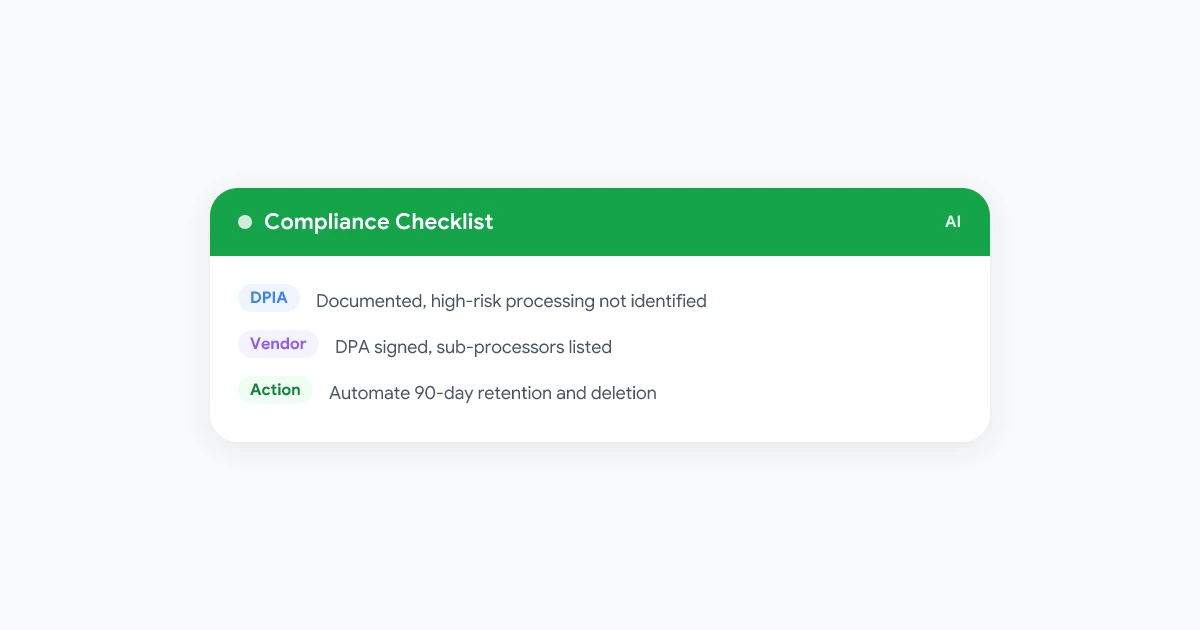
- DPIA completed, or a documented reason why one was not required
- Meeting recording added as its own line in the ROPA
- DPA signed with every recording and transcription vendor, sub-processors listed
- SCCs or another valid mechanism in place for any non-EU data transfer
- Works council or employee representative consultation completed, where applicable
- Security measures checklist reviewed against the vendor’s actual settings
- Retention periods automated, not manual
- Breach response steps specific to recordings written down
Pair this checklist with our meeting recording policy template to turn it into a document your whole team can follow, and our meeting recording etiquette guide for the day-to-day norms that keep recording from feeling invasive.
Frequently Asked Questions
Bottom Line
Meeting recording GDPR compliance is a paperwork problem as much as a policy one. Get the fundamentals right first, lawful basis, notice, retention, then close the gaps that actually show up in audits and security questionnaires: a DPIA decision, a ROPA entry, signed DPAs with every vendor, works council sign-off where it applies, and a security checklist you can point to on demand.
Build the file once, keep it current as vendors and use cases change, and a recording program that felt risky becomes something you can hand to an auditor without a scramble. Review your current setup against the Record Meeting security overview as a starting point.